Virtualization • Clustering • Backup Architecture
Proxmox Virtualization Cluster
Overview
This project began as a personal challenge to deepen my understanding of virtualization and build a realistic, multi-node environment using Proxmox. Instead of relying on a single server, I designed a full cluster to learn how distributed systems behave, how nodes communicate, and how backups integrate into a larger infrastructure.
The setup includes three mini PCs configured as Proxmox cluster nodes and a fourth mini PC dedicated as a Proxmox Backup Server. This architecture mirrors production-style environments and gave me hands-on experience with clustering, quorum, storage configuration, and centralized backup workflows.
The most valuable part of this project was the troubleshooting process. Throughout the build, I encountered configuration issues that required researching community forums, reading GitHub documentation, and using AI tools to interpret logs and errors. Each issue became an opportunity to strengthen my diagnostic skills and understand the underlying mechanics of Proxmox.
The final result is a fully functional, stable Proxmox cluster with a dedicated backup server. It now serves as the backbone of my homelab, providing a reliable platform for future virtual machines, containers, and experiments. More importantly, it reflects my persistence, resourcefulness, and commitment to continuous learning.
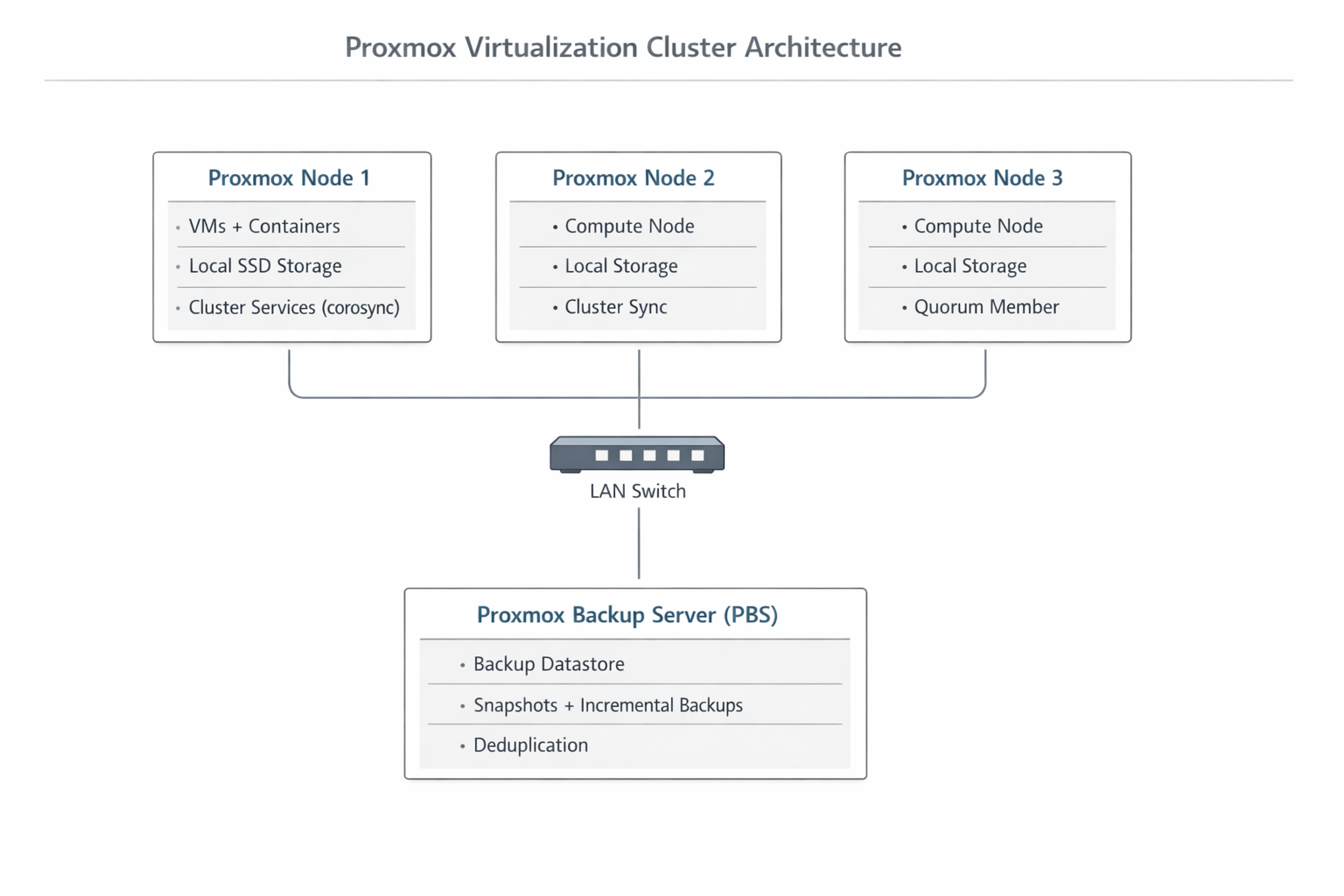
Technical Architecture Overview
- Three-node Proxmox VE cluster forming a quorum-based virtualization environment
- One Proxmox Backup Server (PBS) providing centralized backup and snapshot retention
- All nodes connected through a dedicated LAN via a central network switch
- Local storage on each node with optional replication and scheduled backups
Compute Nodes (Proxmox VE Hosts)
- Node 1: Runs VMs and containers, participates in quorum, local SSD storage, corosync cluster services
- Node 2: Additional compute capacity, supports live migration, synchronized cluster configuration
- Node 3: Third quorum member, ensures cluster stability, hosts workloads and HA logic
Proxmox Backup Server (PBS)
- Dedicated mini PC running Proxmox Backup Server
- Receives scheduled backups from all three Proxmox nodes
- Stores VM and container backups with deduplication and incremental snapshots
- Connected to LAN for fast backup and restore operations
Networking Layer
- Central network switch connecting all four mini PCs
- Handles cluster communication (corosync), management traffic, and backup traffic
- Optional VLAN segmentation for management, VM networks, and backup isolation
Storage Architecture
- Local SSD storage on each Proxmox node for VM disks
- PBS datastore for snapshots, backups, and retention policies
- Optional ZFS for redundancy and replication jobs
Management & Access
- Proxmox Web UI accessible from any node
- SSH access for troubleshooting and configuration
- PBS Web UI for backup management and restore operations
- Cluster configuration synchronized automatically across all nodes
This architecture reflects a production-style virtualization environment built entirely within my personal homelab. It demonstrates my ability to design distributed systems, troubleshoot complex configuration issues, and build reliable infrastructure using open-source tools and hands-on experimentation.